|
Verlagsinformation :: Publisher's information
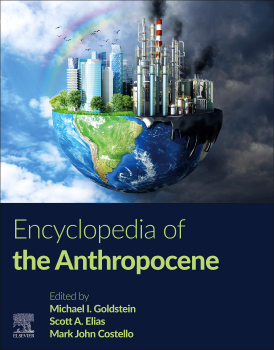
Encyclopedia of the Anthropocene, Second Edition, Four Volume Set, once again provides a topical-based synthesis of the unprecedented rise of humanity’s ecological footprint, the result of exponential population growth, coupled with run-away consumption of the planet’s finite ecosystem services. This new edition captures our current understanding of the actual effects of human population growth on the world’s resources, whether climate change, biodiversity loss, deforestation, soil erosion, poor air quality, or undrinkable water.
Since publication of the first edition, the Anthropocene has been even more widely debated among scientists, humanists, conservationists, industry leaders, politicians and others over precisely when it began, what to call it, if it should be an official geological epoch, whether it can be contained in time, and how it will affect future generations. Sustainability has been a growing issue for the Earth's ecosystems in the Anthropocene. Humans are now using up the world's natural resources at an unsustainable rate. This is causing huge problems for the natural ecosystems, agricultural systems, and water supplies, especially in the Global South. Climate change research, through field observation and remote sensing, has enabled improved understanding of ist effects, allowing us to project future effects and the adaptation measures they require. These are essential topics - all of which are fully covered in the encyclopedia.
Given the high degree of public and media attention on these topics, a revised edition is timely. With over 200 concise and focused chapters written by leading scholars in the field, this reference work is uniquely positioned to make this knowledge accessible to a wide, global audience.
Key features
- Comprehensive and accessible: this title is a unique resource bringing together the many facets of research on the Anthropocene in over 200 accessible, structured chapters. Links and references allow readers to make connections and dig deeper into specific topics
- Fully up to date: includes our most recent understanding of topics ranging from energy and sustainability to the biodiversity crisis and climate change
- Relevant: new emphasis is given to social dimensions, looking, for example, at intrinsic and cultural biodiversity values, the responsibilities of people, industries, and governments in climate change, and environmental law
- Global appeal: the global scale of debate surrounding the Anthropocene is reflected in the large and international pool of chapter authors
Readership
Students and researchers in a wide array of Earth and Environmental Sciences, including, but not limited to, geology, ecology and environmental ethics
|