|
|
|||
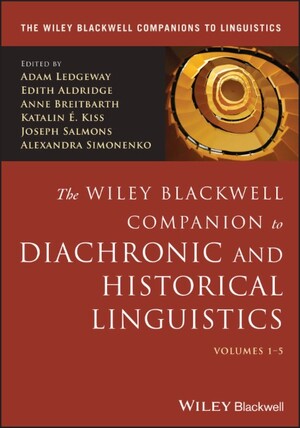
The Wiley Blackwell Companion to Diachronic and Historical Linguistics |
Kontakt/Bestellung
Contact/Order: info@digento.de 
|
|
1st Edition 2025 |
|
|
Online |
|
|
Inhalt :: Content Standardreferenzwerk zur diachronen Linguistik, das aktuelle Theorien, Methoden und empirische Befunde zur sprachlichen Veränderung zusammenführt. Das Werk zielt darauf ab, theoretische Modelle mit empirischer Forschung zu verbinden sowie interdisziplinäre Bezüge (z. B. Psychologie, Anthropologie, Soziologie, Biologie) herzustellen. Behandelt werden Kernfragen wie z. B. Mechanismen des Sprachwandels, historische Grammatik, Methoden der Rekonstruktion, Korpus‑ und quantitative Ansätze, Sprachkontakt, Soziolinguistik des Wandels sowie Fallstudien zu einzelnen Sprachfamilien und Sprachwandelphänomenen. Der Online-Ausgabe liegt die 2026 veröffentlichte, 5-bändige Printausgabe zugrunde. |
|
|
Verlag :: Publisher Wiley-Blackwell (Blackwell Publishers) |
|
|
Preis :: Price Preise auf Anfrage / Prices on request |
|
|
Das Angebot richtet sich nicht an Verbraucher i. S. d. § 13 BGB und Letztverbraucher i. S. d. PAngV. |
|
|
ISBN/ISSN 978-1-119-89802-3 Bestellnummer bei digento :: digento order number 102279133 |
|
|
Verlagsinformation :: Publisher's information The Wiley Blackwell Companion to Diachronic and Historical Linguistics is a state-of-the-art resource that explores the mechanisms underlying linguistic evolution. Bridging the gap between theoretical models and empirical research, this comprehensive work connects linguistics with allied disciplines such as psychology, anthropology, sociology, and biology, and provides an enriched understanding of how language interacts with human society and cognition. Contributions from more than 150 leading scholars cover an unparalleled range of key topics, from phonetics and syntax to semantics, pragmatics, and beyond.
The Wiley Blackwell Companion to Diachronic and Historical Linguistics is ideal for advanced undergraduate, graduate, and postgraduate students in linguistics, particularly those taking courses on diachronic linguistics, historical linguistics, and language change. It is an indispensable reference for researchers and practitioners in fields intersecting with language evolution, including academic and professional linguists, philologists, and anthropologists engaged in exploring the complexities of language development and change. |
|