|
|
|||
Cambridge Histories Online (CHO):
|
Kontakt/Bestellung
Contact/Order: info@digento.de 
|
|
Volume 1: The Ancient World Volume 3: The Sixteenth and Seventeenth Centuries Volume 4: The Eighteenth and Nineteenth Centuries Volume 5: The Twentieth and Twenty-First Centuries Hrsg. v. Nehal Bhuta, Anthony Pagden und Mira L. Siegelberg |
|
|
Online |
|
|
Verlag :: Publisher Cambridge University Press |

|
|
Preis :: Price Preise auf Anfrage / Prices on request
Siehe auch: |
|
|
Das Angebot richtet sich nicht an Verbraucher i. S. d. § 13 BGB und Letztverbraucher i. S. d. PAngV. |
|
|
ISBN/ISSN 978-1-108-93893-8 (Volume 1) Bestellnummer bei digento :: digento order number 10603313 |
|
|
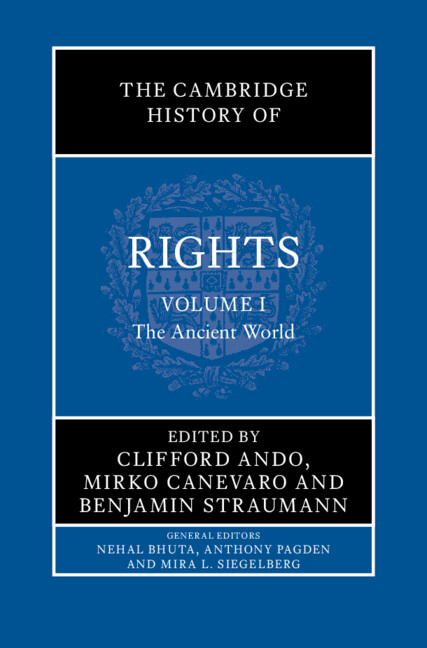
Verlagsinformation :: Publisher's information Volume 1: The Ancient World Edited by Clifford Ando, University of Chicago, Mirko Canevaro, University of Edinburgh, Benjamin Straumann, New York University The ancient world existed before the modern conceptual and linguistic apparatus of rights, and any attempts to understand ist place in history must be undertaken with care. This volume covers not only Greco-Roman antiquity, but ranges from the ancient Near East to early Confucian China; Deuteronomic Judaism to Ptolemaic Egypt; and rabbinic Judaism to Sasanian law. It describes ancient normative conceptions of personhood and practices of law in a way that respects their historical and linguistic particularity, appreciating the distinctiveness of the cultures under study whilst clarifying their salience for comparative study. Through thirteen expertly researched essays, volume one of The Cambridge History of Rights is a comprehensive and authoritative reference for the history of rights in the global ancient world and highlights societies that the field has long neglected. Volume 3: The Sixteenth and Seventeenth Centuries Edited by Andrew Fitzmaurice, Queen Mary University of London, Rachel Hammersley, Newcastle University In the sixteenth and seventeenth centuries, contemporary authors explored the myriad ways in which the concept of rights could be understood but almost always arrived at the same conclusion: It was vital that rights should never be conflated with power. Through twenty-six expertly written essays, Volume III of The Cambridge History of Rights focuses on the language of rights, exploring ist use in contexts as diverse as the English family, trading relations, and Asian powers. This was a period in which rights came to the forefront of political discourse, making it crucial to the longer history of rights reflected in this series. By foregrounding the idea of rights in action, the volume considers the relationship between the ways in which rights were articulated – by individuals, institutions, and states – and how they were enacted in practice. In doing so, it uncovers the complexities inherent in the development of the language of rights during this formative period. Volume 4: The Eighteenth and Nineteenth Centuries Edited by Dan Edelstein, Stanford University, California, Jennifer Pitts, University of Chicago
Volume 5: The Twentieth and Twenty-First Centuries Edited by Samuel Moyn, Yale University, Connecticut, Meredith Terretta, University of Ottawa The concept of a right, and the idea of human rights, were familiar abstractions on the brink of the twentieth century. But the history of political mobilization since shows that human rights had a transformative capacity in that century that no prior age had demonstrated. Through the twentieth century, human rights became institutionalized internationally in laws, movements, and organizations that transcended state-based citizenship and governance – which irrevocably changed the politics around them. Rights continued to evolve as the imperial world order transitioned to a postcolonial world of sovereign states as a primary form of political organization. Through twenty-six essays from experts around the world demonstrating how this period is historically distinctive, volume five of The Cambridge History of Rights is a comprehensive and authoritative reference for the history of rights in the twentieth and twenty-first centuries. |
|