|
|
|||
Cambridge Histories Online (CHO):
|
Kontakt/Bestellung
Contact/Order: info@digento.de 
|
|
Volume 1: Ancient Europe Volume 2: Medieval and Early Modern Europe Volume 3: Modern and Contemporary Europe
|
|
|
Online |
|
|
Verlag :: Publisher Cambridge University Press |

|
|
Preis :: Price Preise auf Anfrage / Prices on request
Siehe auch: |
|
|
Das Angebot richtet sich nicht an Verbraucher i. S. d. § 13 BGB und Letztverbraucher i. S. d. PAngV. |
|
|
ISBN/ISSN 978-1-139-05375-4 (Volume 1) Bestellnummer bei digento :: digento order number 10603313 |
|
|
Verlagsinformation :: Publisher's information Volume 1: Ancient Europe
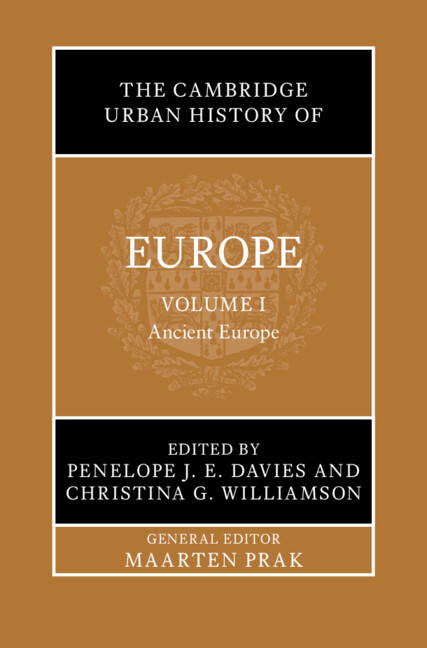
Edited by Penelope J. E. Davies, University of Texas, Austin, Christina G. Williamson, Rijksuniversiteit Groningen, The Netherlands Volume I offers a broad perspective on urban culture in the ancient European world. It begins with chronological overviews which paint in broad brushstrokes a picture that serves as a frame for the thematic chapters in the rest of the volume. Positioning ancient Europe within ist wider context, it touches on Asia and Africa as regions that informed and were later influenced by urban development in Europe, with particular emphasis on the Mediterranean basin. Topics range from formal characteristics (including public space), water provision, waste disposal, urban maintenance, spaces for the dead, and border spaces; to ways of thinking about, visualising, and remembering cities in antiquity; to conflict within and between cities, economics, mobility and globalisation, intersectional urban experiences, slavery, political participation, and religion. Volume 2: Medieval and Early Modern Europe Edited by Patrick Lantschner, University College London, Maarten Prak, Universiteit Utrecht, The Netherlands
Volume II charts European urbanism between 700–1850, the millennium during which Europe became the world's most urbanised region. Featuring thirty-six chapters from leading scholars working on all the major linguistic areas of Europe, the volume offers a state-of-the-art survey that explores and explains this transformation, how similar or different such processes were across Europe, and how far it is possible to discern traits that characterise European urbanism in this period. The first half of the volume offers overviews on the urban history of Mediterranean Europe, Atlantic and North Sea Europe, Central and Eastern Europe, and European urbanisms around the world. The second half explores major themes, from the conceptualisation of cities and their material fabric to continuities and changes in the social, political, economic, religious, and cultural histories of cities and towns. Volume 3: Modern and Contemporary Europe
Edited by Dorothee Brantz, Technische Universität Berlin, Gábor Sonkoly, École des Hautes Études en Sciences Sociales, Paris Volume III uncovers the radical transformations of European cities from 1850 until the twenty-first century. The volume explores how modern developments in urban environments, socio-cultural dynamics, the relation between work and leisure, and governance have transformed urban life. It highlights these complex processes across different regions, showcasing the latest scholarship and current challenges in the field. The first half provides an overview on the urban development of European regions in the West, North, Centre, East-South-East, and South, and the interconnectedness of European urbanism with the Americas and Africa. The second half explores major themes in European urban history, from the conceptualisation of cities, their built fabric and environment, and the continuities, rhythms, and changes in their social, political, economic, and cultural histories. Using transborder, transregional, and transdisciplinary approaches to discern traits that characterise modern and contemporary European urbanism, the volume invites readers to reconsider major paradigms of European urban history. |
|