|
|
|||
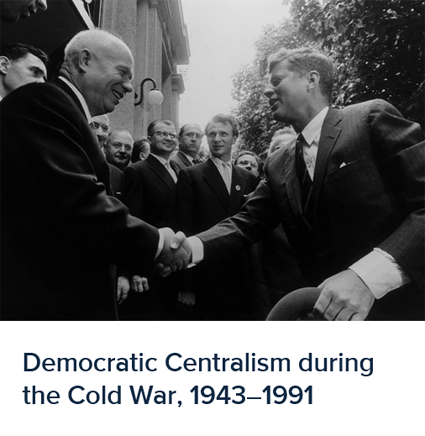
Democratic Centralism during the Cold War, 1943–1991 |
Kontakt/Bestellung
Contact/Order: info@digento.de 
|
|
Online |
|
|
Verlag :: Publisher Microform Academic Publishers (British Online Archive) |
|
|
Preis :: Price Preise auf Anfrage / Prices on request |
|
|
Das Angebot richtet sich nicht an Verbraucher i. S. d. § 13 BGB und Letztverbraucher i. S. d. PAngV. |
|
|
ISBN/ISSN 978-1-85117-173-6 Bestellnummer bei digento :: digento order number 10735136 |
|
|
Verlagsinformation :: Publisher's information Modelled on the Soviet Union’s Central Committee, the Executive Committee (EC) functioned as one of the highest organs of the Communist Party of Great Britain (CPGB). In line with the CPGB constitution, the EC met on a bi-monthly to carry out the decisions made by the annual National Congress. In practice, the EC functioned as a monolithic authority that enforced the rigid tenet of democratic centralism. This was a Leninist principle that stated that once a decision had been made collectively, party members were bound to accept and support it. The EC often used this tenet, as well as its influential position in appointing committee members, to maintain an iron-clad grip on the CPGB. The content featured in this collection, including minutes, handwritten notes, and reports, is drawn from monthly Executive Committee meetings and largely focuses on the politics of the Cold War and the direction of the party. As such, the collection offers a range of communist perspectives on unfolding events in Britain and abroad, from key events during the Cold War to contentious issues over internal party discipline. |
|